
SkidPod
A podcast celebrating community member stories about their digital projects!
Episode 10: Madison, Jefferson, and AI: Who Writes the Next Constitution?
Summary
In this episode, host Ben Harwood speaks with Professor Beau Breslin, political scientist at Skidmore College and author of A Constitution for the Living: Imagining How Five Generations of Americans Would Rewrite the Nation’s Fundamental Law. Breslin shares his bold thought experiment: What if Thomas Jefferson, not James Madison, had won the argument over whether each generation should draft its own constitution? Imagining five generational conventions across American history, Breslin explores how shifting cultural and political moments—from Reconstruction to the civil rights era—might have reshaped the nation’s foundational document. The conversation turns to contemporary challenges, including structural issues like Senate reform, judicial term limits, and hot-button rights debates around gun control, abortion, LGBTQ+ protections, and environmental justice. Breslin also critiques the framers’ blind spots—particularly their failure to anticipate political parties—and proposes that generative AI could offer a neutral constitutional draft to reduce polarization and spark collaboration, much like Madison’s Virginia Plan once did. Central to Breslin’s teaching is the conviction that every American should forge a direct, personal relationship with the Constitution—one that doesn’t rely solely on judicial interpretation but invites civic ownership and critical reflection. The episode closes with classroom insights, where Breslin helps students make sense of a rapidly changing political landscape while urging them to imagine new possibilities for democracy.
Transcript
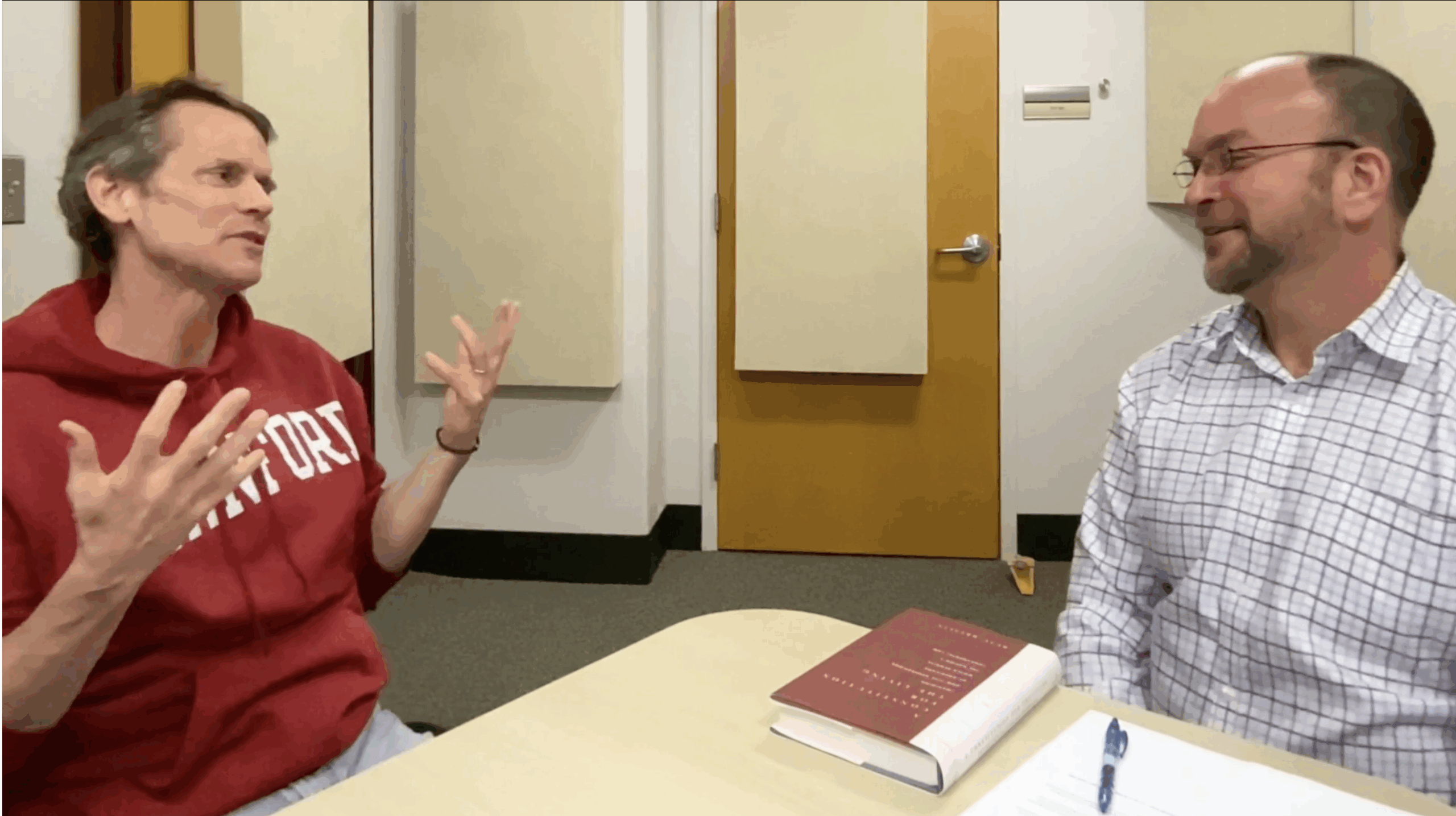
Ben Harwood: Hello, world, and welcome back to the SkidPod. I’m your host, Ben Harwood, instructional designer here in the Learning Experience Design and Digital Scholarship group at Skidmore College, in the Lucy Scribner Library. And today I’m joined by Professor Beau Breslin, professor in the political science department and author of the book, “A Constitution for the Living: Imagining How Five Generations of Americans Would Rewrite the Nation’s Fundamental Law.” So, Beau Breslin, please tell us a little bit about yourself before we dive into your your book.
Beau Breslin: Yes, sure. Thank you so much for having me on the podcast. I’m super excited to be here. It’s an interesting time to be talking about the Constitution, for sure. I’m a political scientist, and I’ve been at Skidmore for a long time. I’ve been interested in the Constitution since I was an undergraduate. I teach traditional courses on public law here, which is constitutional law, civil liberties, judicial process sequence. I write primarily about the texts themselves, the constitutions themselves. It’s a little bit different than what I do in the classroom.
Beau Breslin: In the classroom, we’re talking about how the Supreme Court interprets constitutions. My work is really about constitutions generally. That said, there’s obviously a lot of overlap. I’ve been interested in the Constitution ever since I was an undergraduate. As an undergraduate, I realized that you could create a world from a piece of parchment, right? The founders and late 18th century America sat down to think about what is the best political design they could come up with. And they wrote it down. And now we live in that world like, that’s pretty mind blowing to think about the fact that bombs and bullets don’t need to change worlds, but parchment paper will change the world. So I’ve been interested in constitutions for about 40 years.
Ben Harwood: Your book captures very intense scholarship, but it also makes it somewhat accessible to the public at large. You open, in your preface, you talk about visiting a museum. It’s in Philadelphia, about the Constitution..
Beau Breslin: That image of being in Philadelphia and going to the National Constitution Center. And you are forced in that museum… you are forced to make a decision about whether you would ratify the Constitution and it asks you to reflect on your reverence for the Constitution, your disdain for the Constitution, just like they did in 1787 and 1788 when they were voting up and down on ratification. And there is a an actual moment in which you’re asked to either sign or not sign the Constitution. And I think that’s a super important moment.
Beau Breslin: What I like to say to my students is that they should forge a personal relationship with the Constitution itself. The way it works now, as you know, the way it works now is there’s always an intermediary. We think about that constitution that changed the world. We think about it through the intermediary of the judiciary. Judiciary tells us what various clauses of the Constitution say. And I actually think that’s a mistake as a citizen of the United States, as somebody who cares about civic education, we ought to forge a relationship with the Constitution itself.
Beau Breslin: This book itself is a kind of a thought experiment. It’s a speculative history thought experiment. And the elevator pitch of this book is that Madison and Jefferson disagreed about the enduring nature of a constitution. Madison thought a constitution should last for 50, 100, 150 years in order to build up the credibility and reverence so that it would be authoritative in a country like the United States. Jefferson thought that was a form of tyranny, right? That they had a constitution 150 or now 238 years old, written by a generations past, was just another form of tyranny. And each generation, Jefferson said, ought to write its own constitution. And they fought about it their whole lives. They disagreed on it their whole lives.
Beau Breslin: My book imagines that Jefferson won that debate. We know Madison won the debate and the Constitution is 238 years old. But if Jefferson had won that debate, what would those constitutions have looked like in American history? And so I just imagine what five generations of Americans would have written down in their Constitution if they had a chance to go back to Philadelphia and do a new constitutional convention at periodic moments in American history.
Ben Harwood: In your book you have five conventions. If we were to have a convention today, what what issues would we be talking about?
Beau Breslin: I think there would be structural topics. Do we still want only a four year president? Maybe we want a six year president. Or maybe we want an eight year president. And that president can only sit for one term so that the president automatically is a lame duck, but has eight years to kind of do the work. Do we still want a federal judiciary that has life tenure? Probably not. 18 year terms? I think one of the major structural changes that would come about today at a constitutional convention is term limits for Congress. The Senate is absurd. The Senate is ridiculous because California has 40 times the population of Wyoming. And yet they have the exact same representation in the Senate. So it’s the most anti-democratic legislature in the world… is the Senate.
Beau Breslin: Then you’d have the social cultural issues, issues of rights. How do you deal with gun control and abortion and same sex marriage and trans identity and LGBTQ+, environmental issues that would come. No constitution that’s been written in the last 50 years at the international level doesn’t have some clause about protecting the environment. We don’t. Our Constitution does not. So I think there’d be structural issues that we could talk about and would be part of a constitutional convention. I think there would be rights-based social, cultural issues, and environmental issues.
Ben Harwood: Why isn’t there any mention of political parties in the Constitution?
Beau Breslin: Because they didn’t exist. I mean, this is as simple of an answer we’re going to get: because the framers in the late 18th century America did not anticipate political parties. The Constitution, I will always tell my students, the Constitution changed the world. Why? Because it’s the longest enduring national constitution. It’s not the first. Articles of Confederation is the first. But the Articles was just a confederation of separate states. So it, you know, it’s like it’s like the EU. I mean, it’s not, it’s a thin connection with the Articles of Confederation. So our Constitution is really the first kind of really national constitution, written constitution.
Beau Breslin: Now, today, all but three of the nations of the world have a written constitution. In 1787, we were the only one. And nowadays all but three. The UK doesn’t have one, New Zealand and Israel. But every other country in the world has a constitution. Our Constitution kind of set the table. That’s part of the reason why we revere it. But the men who wrote it were flawed. And quite frankly, the men who wrote it, a lot of them were drinking most of the time, too. Well, I don’t know. I don’t necessarily. But it’s late 18th century. They spent a lot of time in the taverns, and so they have blind spots. And one of their major blind spots is they didn’t anticipate political parties.
Ben Harwood: Okay.
Beau Breslin: Nowadays, as you know, let’s go to the constitutional convention. You have to do something about political parties. Take Congress and the presidency today, right? It’s all about political parties. What would be the thing that Madison would most be angry about? It’s probably the rise and eclipse of political parties above everything in American politics, or at least at the national level, because they didn’t anticipate them.
Ben Harwood: What kinds of magical moments come out for students in your in your kind of experiment, your democracy experiment in your class?
Beau Breslin: I’ve had to do something this semester in my introduction to American Politics class that I’ve never had to do before. Once every three weeks, I’ve had to stop the class, spend an hour exploring the questions that they have about what is an unconventional Washington, D.C., Because a: the news cycle is so short; and b: there’s all sorts of unconventional activity happening in Washington today, especially in the White House. I’ve had to stop and say, all right, folks, let’s dissect what’s going on.
Beau Breslin: Tariffs. Immigration. Then when I have to pivot and talk about, you know, whether it’s Abrego Garcia in El Salvador or not being able to come back despite the fact that the Supreme Court said, you got to come back and I got to pivot and talk to my students about that sort of stuff. I have to weigh the the various value and the different value of either sticking to the traditional syllabus or having a moment. And I think right now students are looking for the pivot.
Beau Breslin: When I teach my upper level constitutional law and civil liberties classes, over the course of my career, I’ve come to understand that this conservative court really is shaking the foundation of constitutional law, right? It’s been a long time since we’ve had a very solid partisan court. So now you have to think about constitutional law and civil liberties in classes in a slightly different way because of the way in which this court has decided to sort of impose what is a very partisan position on a lot of different issues.
Beau Breslin: Let’s talk about AI. Artificial intelligence can do a bang up job in the amount of time it takes us to finish this podcast, to write a beautiful constitution forwards and back. And let me tell you a brief story about the founding edit and then as it relates to Generative AI or, you know, figuring out a way in which AI could could draft a document for us. So I tell my students to pull a Madison at some point in their lives. And what I mean by that is Madison was was brilliant.
Beau Breslin: He was, you know, he had some flaws for sure, but he was brilliant in a couple of ways. One, he sort of kept all of this, you know, design in his head. But two, he understood the politics of the moment. And so he arrives in Philadelphia. He’s from Virginia, as you know, and he arrives in Philadelphia in the summer of 1787, ready to go. And actually, the the story is that the Pennsylvania delegation, Franklin and the Virginia delegation sort of met beforehand before the convention starts, right?
Ben Harwood: The meeting before the meeting. [laughter]
Beau Breslin: The meeting before the meeting. [laughter] So there’s a meeting before the meeting and a lot of what was crafted, a lot of what ended up being in the Constitution was was decided in those, you know, wonderful dinner parties at Franklin’s house. But anyway, Madison understood how to play the room. And so what he does, he crafts a document. He comes with what’s called the Virginia plan. And you’ll might remember that from your senior year of high school, the Virginia plan and the New Jersey plan. And so he comes with the Virginia plan on day one. And he literally you know, he didn’t do it. Randolph did it. But Madison metaphorically throws it on the table. The Virginia plan. Why is that a brilliant move? Because ultimately, then the conversation from then on becomes a conversation about Madison’s Virginia plan. Right? He sort of had the document, and that’s exactly what he wants, because he wants his vision.
Beau Breslin: What I think could happen now in a deeply polarized America, where I might go to Philadelphia and I might have somebody who completely disagrees with me on the political spectrum. What generative AI could do is give you a draft to work with that wouldn’t require me and that person I disagree with completely, to agree, you know, on basic stuff. So then it becomes a conversation about that. And how do you tweak it.. It wouldn’t solve all of our problems because there’s polarization everywhere. You have a document that becomes the talking point. It solves at least 10% of the polarization problem, because now we’re all trying to work with this one document.
Beau Breslin: And you can’t do it as an individual. Because if I come in there with an already written document, the person who’s on the ideological, polar opposite of me is going to is not going to think it’s credible. But if it’s a generative AI designed document, it becomes a little bit more palatable that we can have a conversation about how to tweak it here or there. It’s not going to solve all of our problem, but I actually think I would do a good job of, starting the ball rolling in the same way that Madison did with the Virginia Plan.
